
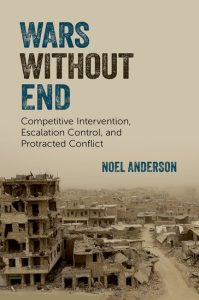
The Conflict Research Society congratulates Noel Anderson on winning the 2026 Conflict Research Society Book of the Year Prize for his book titled Wars Without End: Competitive Intervention, Escalation Control, and Protracted Conflict.
At a time when a large majority of civil wars continue to attract some form of external support, Noel Anderson’s Wars Without End makes a major contribution to our understanding of how such involvement shapes conflict dynamics. Anderson’s central argument is that many civil wars become protracted because rival external states simultaneously support opposing sides in what he terms “competitive intervention”. In these situations, interveners face a dual imperative: they want their local clients to prevail, yet they also seek to avoid direct escalation with rival interveners. This produces a pattern of calibrated support that is sufficient to keep local partners fighting but insufficient to deliver decisive victory, producing seemingly endless civil wars.
The prize committee received over 40 nominations from conflict and peace researchers, institutions, practitioners, and publishers around the world. The winning title was selected from a shortlist of four outstanding books, based on criteria including the significance of its contribution to conflict and peace studies, policy relevance, methodological rigor and credibility of the findings, innovation, interdisciplinarity, and quality of writing.
Anderson particularly impressed the jury by moving beyond the general observation that external support is associated with worse conflict outcomes and identifying a precise mechanism through which it can prolong war. The concept of “competitive intervention” is a novel contribution and offers a theoretically elegant and intuitively compelling explanation for why external involvement so often sustains rather than resolves civil conflict. By shedding light on the strategic calculations of rival sponsors, the book makes an important contribution to research on conflict duration, external support, and proxy warfare.
The book combines statistical analysis with case studies of Angola, Afghanistan, and Syria. These analyses draw on an impressive body of evidence, including original data collection on external support, fieldwork, original interviews, declassified intelligence reports, and archival research. Through this rich empirical foundation, Anderson documents the consequences of competitive intervention for civil wars.
The book’s findings carry important implications for contemporary conflicts and for policymakers considering military assistance as a tool of conflict management. At the same time, the book offers a cautiously optimistic message: while external support remains widespread and has increased on several indicators, competitive intervention has become less prevalent since the end of the Cold War. Anderson argues that this shift has contributed to shorter average conflict durations and a decline in the global prevalence of civil war.
Congratulations to Noel Anderson on a timely and important book that significantly deepens our understanding of the international dynamics that sustain protracted civil wars.
This year’s winner was selected from a shortlist of four exceptional books.
The judges commended the overall high quality of research in all the shortlisted titles. We extend our congratulations to the following runners-up (in alphabetical order):
Rachel A. Epstein and Oliver Kaplan (eds.). Speaking Science to Power: Responsible Researchers and Policymaking. Oxford University Press. For its thoughtful examination of the opportunities and dilemmas involved in bridging the gap between academic research and policy engagement, providing valuable guidance for researchers and policymakers alike on fostering meaningful engagement while guarding against the misuse of scientific evidence.
Jenny Hedström. Reproducing Revolution: Women’s Labor and the War in Kachinland. Cornell University Press. For its innovative theorization of “militarized social reproduction”, demonstrating how revolutionary warfare depends on often invisible forms of gendered labour. Grounded in several years of in-depth fieldwork with women in Myanmar’s Kachin revolution, and remaining accessible and engaging throughout, the book makes an important contribution to scholarship on gender and armed conflict.
Eric Min. Words of War: Negotiation as a Tool of Conflict. Cornell University Press. For its original contribution to the study of wartime diplomacy, challenging the conventional view that negotiations are primarily tools for ending conflict and demonstrating, through impressive statistical analyses and historical case studies, how leaders use wartime diplomacy strategically to improve their position and advance their prospects of victory.
Special thanks to the 2026 CRS Book Prize Judges: Zorzeta Bakaki, Isabel A. Phillips, David Randahl, and Corinne Bara (Chair).